AI & hyperscale data centers
Support for critical computing loads and power-quality-sensitive operations.
Applications
Impulse Inertia is being developed for facilities where even a brief loss of power can have substantial operational consequences.
Where it matters
Support for critical computing loads and power-quality-sensitive operations.
Continuity and frequency stability for sensitive, high-value production processes.
Thermal and electrical integration for operations where downtime is costly.
Potential reinforcement and resilience in selected grid-connected applications.
Resilience concepts for facilities with demanding continuity requirements.
Potential alternatives for isolated critical infrastructure.
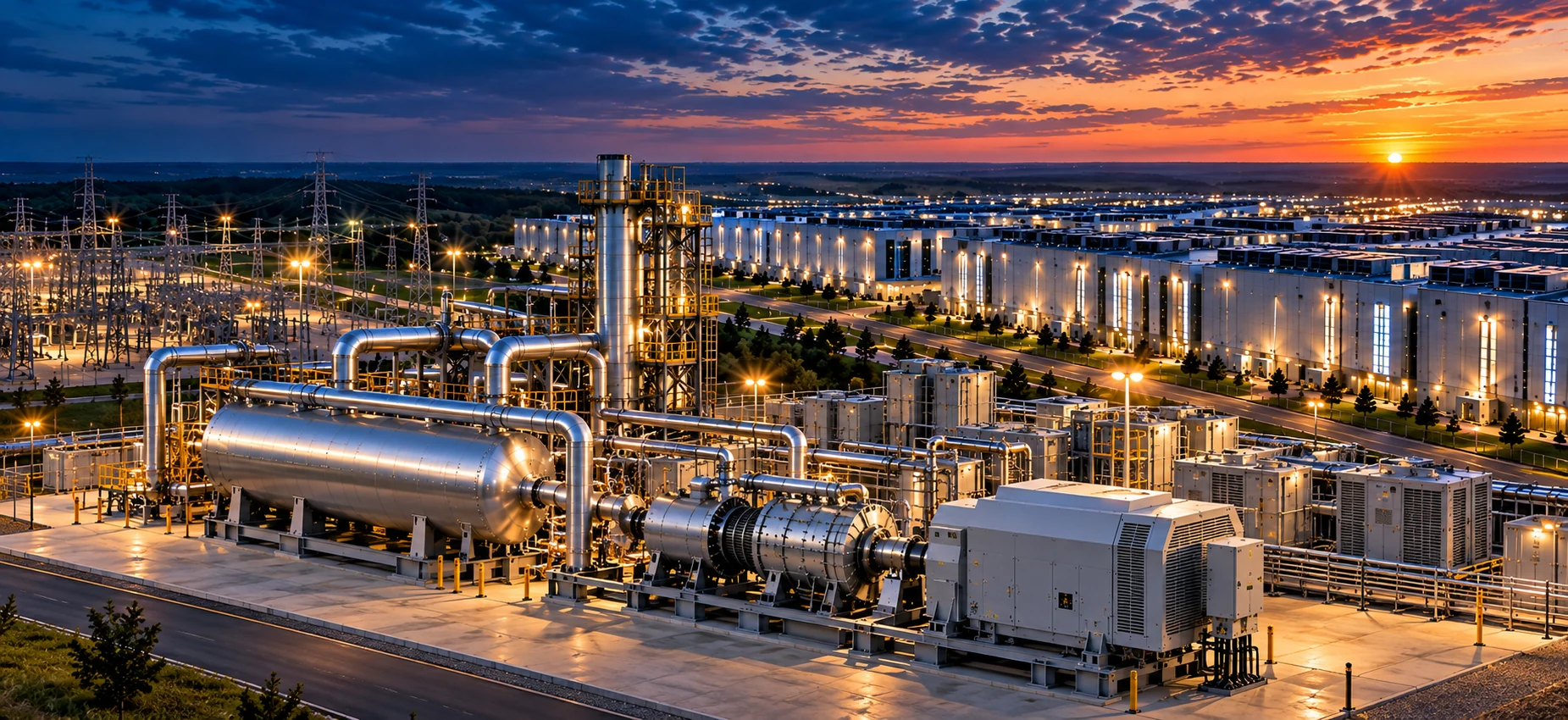
Original application context
AI & Hyperscale Data Centers
High-density computing campuses demand reliable, large-scale electrical generation and resilience to abrupt changes in load. Impulse Inertia's shaft-level torque reinforcement is intended to help limit generator speed and frequency decay during power disturbances.
Unified Continuity Architecture™ offers a further approach to transitioning from rotating standby readiness to sustained prime-mover generation.
Semiconductor Manufacturing Campuses
Large semiconductor fabrication campuses combine significant power demand with processes sensitive to electrical disturbances. Integrated rotating generation and supplemental shaft torque may provide another layer of continuity for campus-scale power systems.
Major Industrial & Process Facilities
Refining, chemical processing, metals production and other energy-intensive industries can experience major operational losses from generator trips and frequency excursions. The technology is intended for integration with substantial rotating generation assets supporting continuous operations.
Utility-Scale & Large Distributed Generation
Large synchronous generation systems and industrial microgrids may benefit from supplemental rotational support and coordinated transitions between standby and sustained generation. Patent #2's clutched-engine and reduced-pressure combustion-turbine embodiments address two distinct ways to keep a generator ready while managing standby losses.
Generation already in motion.
Across these applications, the objective is consistent: preserve useful rotating energy, reinforce generator shaft torque during a disturbance, and coordinate the transition to sustained generation. Suitability and performance depend on the configuration, load profile and engineering validation.
Work with Impulse
Discuss your project requirements, validation pathway, licensing, or strategic partnership opportunities.
Start a conversation ↗