Mission-Critical Power · Already in Motion

Power Continuity.
Frequency Support.
Already in Motion.

Impulse Inertia™ keeps a synchronous motor-generator online, synchronized and rotating at synchronous speed while supplying essentially no real-power load. When external power is interrupted, the already-rotating machine can transition to generator operation without first accelerating from rest. Stored energy drives an auxiliary steam turbine to supply immediate shaft torque, helping maintain speed, electrical frequency and continuity while sustained motive power becomes available.

Two Patent-Pending Technologies | Impulse Inertia™ + Unified Continuity Architecture™

Patent-pending technology · United States
The Defining Operating Condition

Already Synchronized.
Already Rotating.
Ready to Generate.

The generator is not parked, disconnected or waiting to accelerate. During normal operation, the synchronous machine remains electrically connected and synchronized to the available power source, turning at synchronous speed while delivering essentially zero net real power to the facility. It operates in a motor-driven, no-load standby condition, drawing only the power required for rotational and electrical losses.

01 · Normal

Online. No load.

The motor-generator is synchronized and held at speed by external power. Stored motive energy is charged and ready.

02 · Outage

Already at speed.

Protective controls isolate the failed source and configure the machine to deliver electrical power. No generator acceleration from rest is required.

03 · Reinforcement

Steam adds torque.

Stored energy drives the mechanically coupled auxiliary steam turbine, countering shaft deceleration as the generator supplies load.

04 · Continuity

Bridge to sustained power.

Steam-turbine support bridges the transition until the primary or standby prime mover can carry the electrical demand.

The essential difference: Conventional standby generation starts with a stationary generator. Impulse Inertia starts with the generator already rotating at synchronous speed, so its stored kinetic energy and supplemental steam-turbine torque are available at the onset of the transition.

“No load” refers to essentially zero net real-power output in standby, not zero electrical consumption. Transfer performance depends on protection, switching, excitation, controls, available stored energy and the connected load.

Why Now

The Power Infrastructure Behind AI Is Becoming the Constraint.

AI data centers need dependable generation and a response to rapidly changing demand. As onsite generation expands, electrical continuity and frequency stability become central considerations alongside capacity and equipment availability.

Frequency Stability

Rapid demand changes need a response.

Sudden load increases can outpace the immediate response of a prime mover. Supporting the rotating generator during that interval is a frequency-stability challenge as well as a power-supply challenge.

Equipment Availability

Generation equipment can become the critical path.

Extended procurement cycles for certain large combustion-turbine projects create a reason to evaluate alternative generation architectures and equipment platforms.

Continuity

The critical load cannot wait.

Mission-critical facilities require immediate continuity during the transition from a disturbance to stable primary or standby generation.

Continuity and frequency support begin at the rotating generator itself.

Frequency Support

Support the Shaft.
Support the Frequency.

For a synchronous generator supplying an islanded load, electrical frequency follows rotational speed. When demand rises faster than the prime mover can respond, the rotor gives up kinetic energy and begins to slow. Impulse Inertia is being developed to counter that deceleration with supplemental shaft torque from stored energy.

01 · Load Increase

Demand changes.
The generator is already turning.

A sudden increase in electrical load creates a temporary imbalance between the power drawn from the generator and the mechanical power supplied to its shaft.

02 · Shaft Reinforcement

Stored energy supplies supplemental torque.

When rotational decay is detected, stored energy is released through the mechanically coupled turbine. The design objective is to limit deceleration and the associated frequency decline.

03 · Prime-Mover Response

Bridge the interval.
Coordinate the response.

Supplemental mechanical power supports the transition while the prime mover increases output. During an interruption, it supports the interval while primary or standby motive power assumes the load.

One Mechanism

Direct shaft reinforcement.

Two Design Objectives

Frequency support during sudden load increases.
Electrical continuity during power interruptions.

Supplemental torque addresses deceleration. Load rejection and rising frequency require coordinated prime-mover and system controls. The response of a grid-connected system also depends on the wider network.

Impulse Inertia™

Respond to Changing Power Conditions With Power Already in Motion.

The synchronous motor-generator is maintained online at synchronous speed in a no-load standby condition. On loss of external power, appropriate protection and switching allow the already-rotating machine to transition to electrical generation. As it begins supplying load, stored energy can be released through a compact, mechanically coupled steam turbine to provide supplemental shaft torque, limit deceleration and support frequency while primary or standby motive power responds.

Impulse Inertia stored-energy system, turbine, generator and data-center power infrastructure
Stored Energy
→
Impulse Turbine
→
Generator Shaft
01 · NORMALGenerator online and synchronized at synchronous speed, with essentially zero net real-power output; stored-energy system charged.
02 · DISTURBANCEExternal power is interrupted or electrical demand rises; protection and controls initiate the required response.
03 · RESPONSEThe already-rotating machine supplies generation after the required electrical transfer; stored energy is released in response to decay.
04 · REINFORCEMENTThe turbine converts stored energy directly into supplemental shaft torque.
05 · SUPPORTSteam-turbine torque supports speed and frequency until sustained motive power assumes the load.

Energy goes directly where it is needed: the shaft.

Direct Mechanical Reinforcement

Generation Stays Generation.

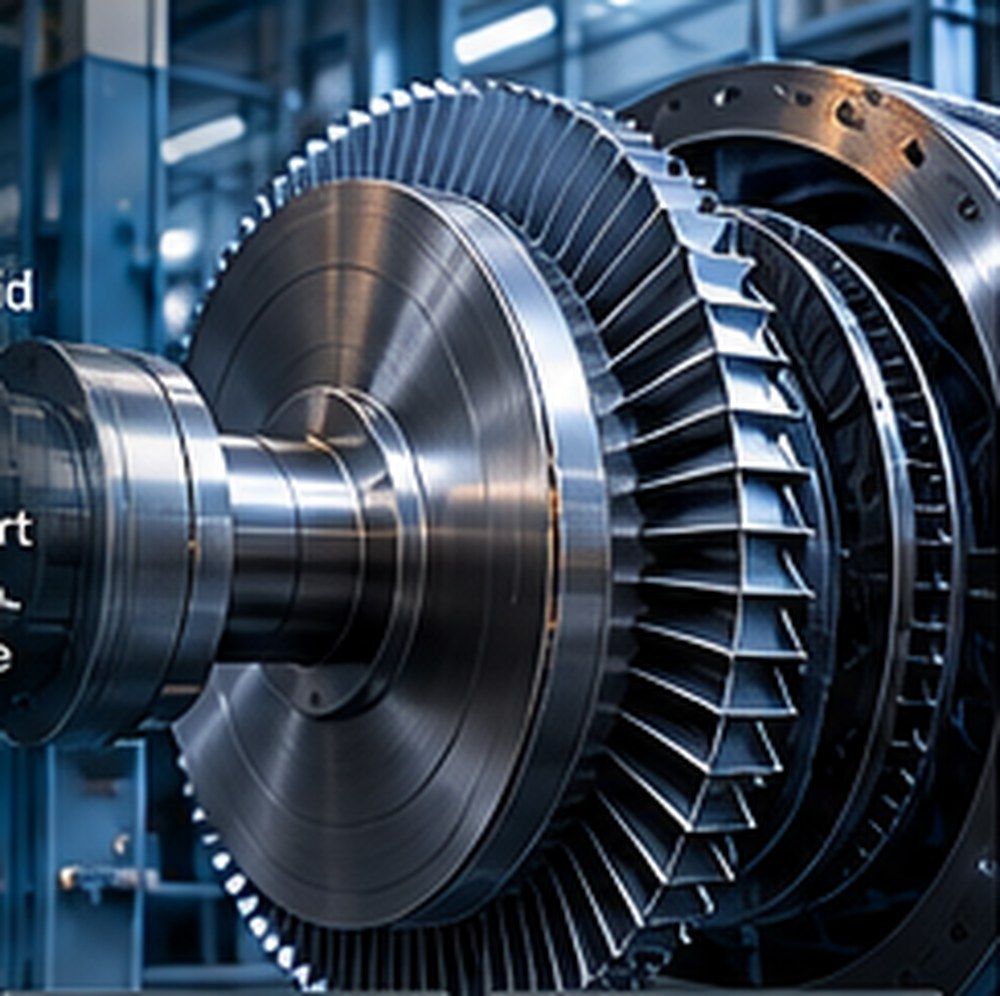
Impulse Inertia approaches short-duration continuity and frequency support by delivering stored energy directly to the rotating generation system. Supplemental mechanical power is intended to bridge the response of primary or standby motive power.

Close view of stored-energy turbine delivering rotational power directly to a generator shaft
Conventional Electrical Bridge

Stored electrical energy supports the load.

Generation → Electrical Conversion → Stored Electrical Energy → Load
Impulse Inertia

Stored energy reinforces generation mechanically.

Stored Energy → Mechanical Torque → Generator
Intellectual Property Platform

Two Patent-Pending Technologies. One Continuity Platform.

Impulse Inertia is developing complementary intellectual property addressing both the immediate mechanical reinforcement of rotating generation and the broader architecture through which generation, ride-through and standby power can operate as a coordinated system.

Patent 01 · Impulse Inertia™

Decay-Responsive Rotational Energy Reinforcement

Direct shaft-level continuity technology

Impulse Inertia™ introduces stored-energy-driven mechanical reinforcement directly at the rotating shaft. When rotational decay is detected following loss or reduction of motive power, stored energy is released through a turbine mechanically coupled to the rotating system. The resulting supplemental shaft torque is designed to counteract deceleration and support rotational stability, electrical frequency and continuity while primary or standby motive power responds.

The fundamental concept: detect rotational decay and respond by injecting mechanical energy directly into the rotating system.

Rotational Decay Detected
Stored Energy Released
Turbine Produces Torque
Shaft Energy Reinforced
Generation Supported
U.S. Patent Application No. 19/683,413 · Patent Pending
Patent 02 · Unified Continuity Architecture™

Integrated Generation, Ride-Through and Standby Power

System-level continuity architecture

Unified Continuity Architecture™ extends the Impulse Inertia concept beyond shaft reinforcement into the organization of the complete mission-critical generation system. The architecture coordinates synchronized rotating generation, stored-energy-driven shaft reinforcement, primary motive power and standby generation so that ride-through and longer-duration generation can function as elements of a unified system.

The objective: reduce redundant infrastructure by allowing generation assets to participate in instantaneous ride-through and sustained standby power.

Synchronized No-Load Standby
Immediate Generator Transition
Impulse Inertia Ride-Through
Primary Mover / Standby Start
Load Transition
Sustained Generation
U.S. Provisional Patent Application No. 64/147,521 · Patent Pending
Patent 1 protects how rotational energy is reinforced.
Patent 2 expands how that capability can reshape the power architecture.

The patent-pending concepts are not presented as limited to a single stored-energy medium, prime mover or generation technology. Illustrations on this site show representative configurations.

Steam Generation

When Turbine Availability Becomes the Critical Path, Architecture Matters.

Extended procurement cycles for certain combustion-turbine projects can affect the schedule for bringing new generation capacity online. Steam-based generation provides another path—and a natural integration opportunity for stored thermal energy and Impulse Inertia.

01 · GENERATE
Steam Generation

Boiler systems provide firm on-site thermal energy and primary generation capability.

02 · STORE
Stored Thermal Energy

High-pressure stored energy is maintained ready for an immediate continuity event.

03 · REINFORCE
Impulse Inertia™

Stored energy is converted directly into supplemental mechanical torque at the shaft.

04 · CONTINUE
Continuous Generation

The rotating generator is reinforced while the broader generation architecture transitions.

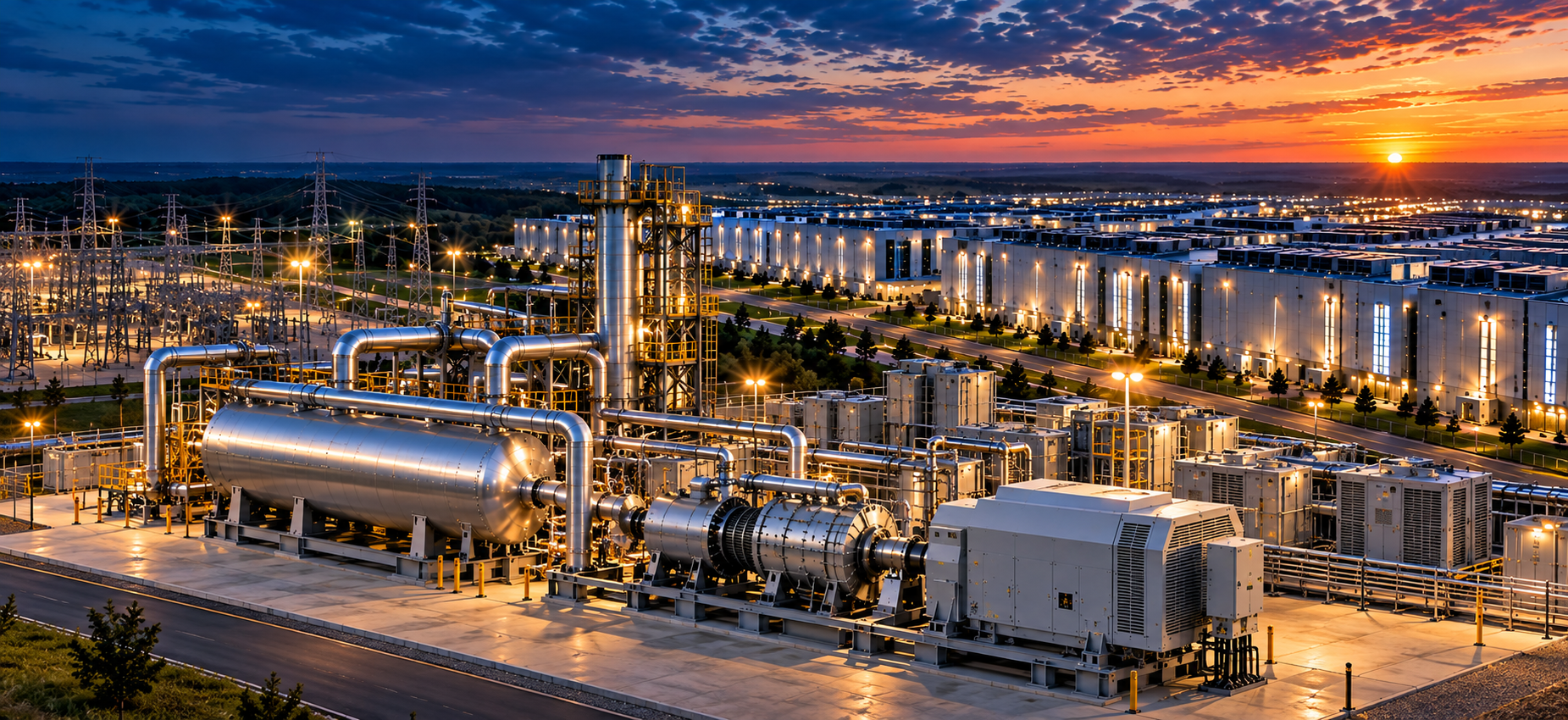
Steam-based power generation integrated with a hyperscale data-center campus

Power generation, stored energy and ride-through can become parts of the same thermal-mechanical architecture.

Unified Continuity Architecture™

Beyond Ride-Through.

The Unified Continuity Architecture™ expands the concept into an integrated system coordinating a synchronous motor-generator maintained online at synchronous speed with essentially no real-power output, rotational inertia, stored-energy steam-turbine shaft reinforcement, primary generation and standby functionality. At an outage, the already-rotating machine transitions to generator operation as supplemental steam-turbine torque supports the shaft. Keeping the generator in motion provides the foundation for coordinated ride-through and frequency support.

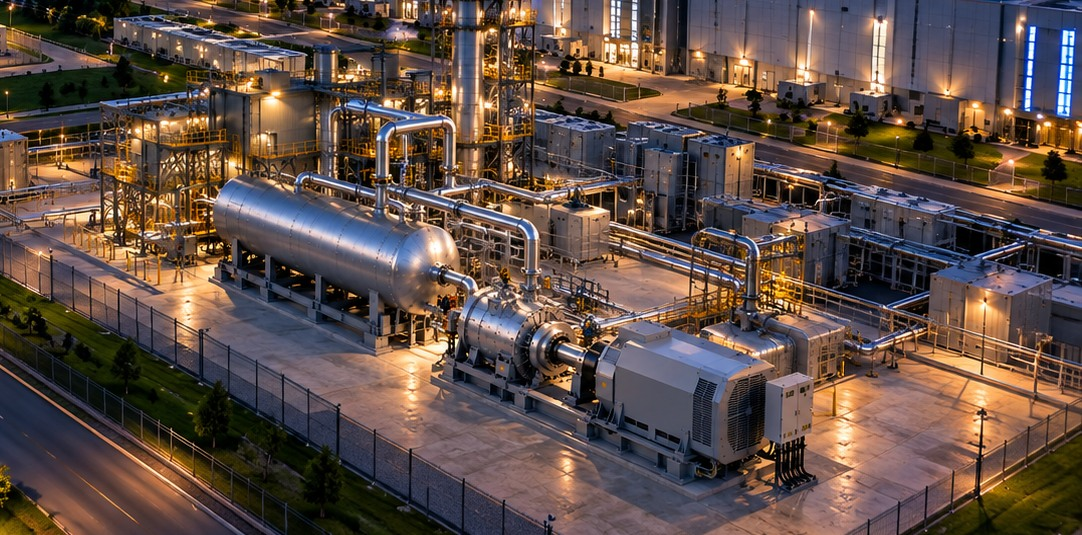
Unified Continuity Architecture integrating multiple generation assets with Impulse Inertia and mission-critical data-center infrastructure

Conceptual visualization of an integrated mission-critical generation campus.

One architecture. Multiple layers of continuity.

Architecture 01

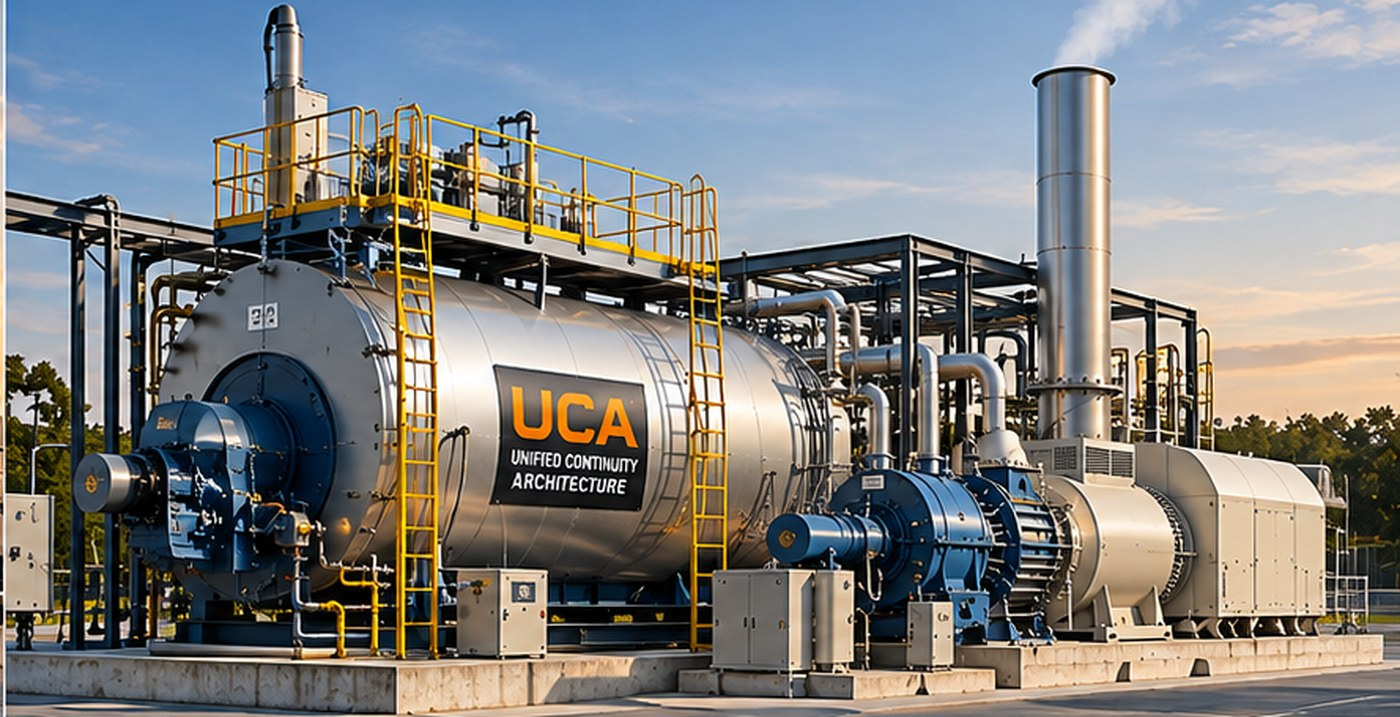
Steam Generation

Stored thermal energy and steam generation can naturally coexist within an Impulse Inertia architecture, creating an integrated approach to generation and continuity.

Architecture 02

Engine & Turbine Generation

Impulse Inertia can reinforce synchronized rotating generation while a reciprocating engine, combustion turbine or other primary motive source transitions or assumes load.

Combustion Characteristics

Cleaner Combustion. Cleaner Exhaust.

Unlike diesel reciprocating generators, which rely on rapid, intermittent combustion at extremely high temperatures and pressures, a steam-based Unified Continuity Architecture can employ continuous, controlled combustion in a packaged steam boiler.

Even when burning the same No. 2 diesel fuel, properly engineered boiler combustion offers the potential for reduced visible smoke, soot, unburned hydrocarbons, and exhaust odors compared with conventional diesel engines without advanced emissions aftertreatment. Continuous combustion also allows precise control of fuel atomization, air-to-fuel ratios, and flame characteristics, promoting cleaner, more complete combustion.
Why It Matters

A Different Way to Support Critical Power.

IN MOTION

The synchronous machine is already online at speed, with essentially zero net real-power output, before the outage occurs.

DIRECT

Stored energy converted into shaft-level mechanical power.

INTEGRATED

Ride-through can become part of the generation architecture itself.

FREQUENCY SUPPORT

Supplemental shaft torque is designed to counter deceleration during sudden load increases.

Generation. Frequency support. Continuity. One coordinated architecture.

Applications

Built Around Loads Where Continuity and Frequency Matter.

AI & Hyperscale Data Centers

Semiconductor Manufacturing

Critical Industrial Infrastructure

Distributed Generation

Utility-Scale Generation

The Opportunity

The Power System Is Being Redesigned.

AI infrastructure and other mission-critical loads are forcing developers to reconsider where power comes from, how quickly generation can be deployed, how continuity and frequency stability are maintained and how much redundant infrastructure is required.

Impulse Inertia is being developed for that transition.

Commercialization & Partnerships

Two Business Models.
One Technology Platform.

Impulse Inertia™ is pursuing commercialization through intellectual-property licensing, OEM partnerships, and opportunities for integrated engineering and project delivery. Our approach provides flexibility in how strategic partners participate in the development and deployment of our patent-pending technologies.

Capital-Light Model

Technology Licensing

Licensing, royalties, strategic development agreements, and OEM integration provide a pathway to commercialization through established power-generation manufacturers and infrastructure providers.

Capital-Intensive Model

Engineering & Project Delivery

Proprietary system engineering, equipment integration, project management, and potential EPC partnerships create opportunities to participate more broadly in large-scale power infrastructure projects.

Strategic Engagement

We Are Looking for the Organizations Building What Comes Next.

Impulse Inertia welcomes discussions with data-center developers, power-generation OEMs, EPCs, energy infrastructure companies, strategic investors and technology partners.